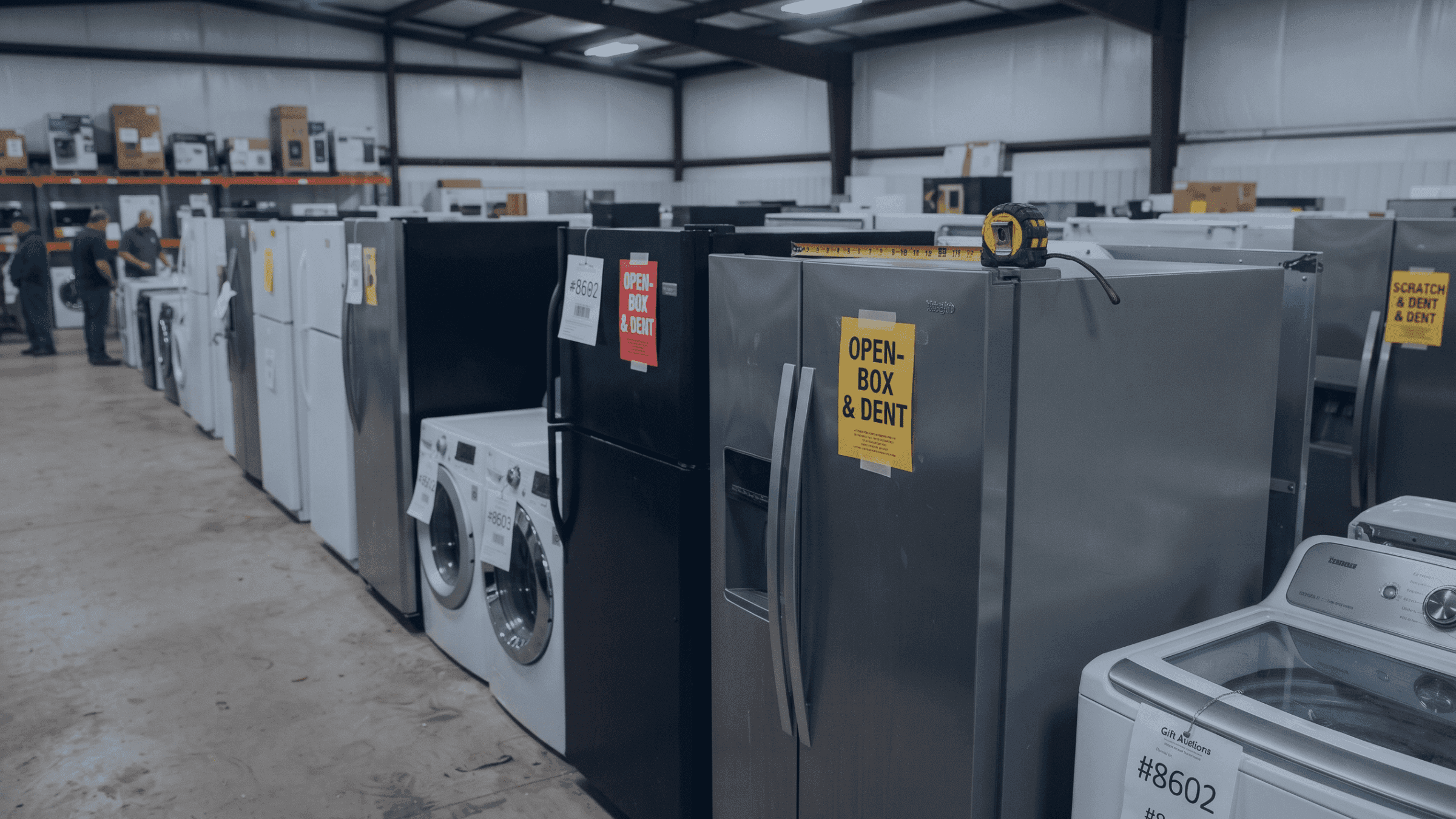
A refrigerator. A washer and dryer. A new range. Maybe that fancy countertop appliance you’ve been eyeing but haven't been willing to pay retail for.
Appliances can be some of the most exciting finds at an online auction.
They can also be purchases where doing a little homework really matters.
The lowest bid doesn't automatically make something the best deal. Condition, comparable value, total cost and how you plan to use the appliance all matter.
Before you stake your claim on your next appliance, here's how to bid smarter.
1. Start with the condition
See an appliance you like?
Before you check the current bid, check the product condition.
At Equip-Bid, you'll generally see five conditions:
Factory Sealed, Appears New, Open Box, Damaged, and Partial or Incomplete.
Understanding the difference is especially important with appliances.
Factory Sealed
The box hasn't been opened and the product hasn't been handled. Because it hasn't been opened, however, the contents inside haven't been verified.
Appears New
The item looks unused; the box may be damaged. It may or may not have its original packaging, but it has been looked over, doesn't appear pre-owned, and appears complete enough to function.
Open Box
The broadest category. An item could be like new, incomplete, untested, or nonfunctioning. Its condition or functionality hasn't been verified either way.
Damaged
There's a known issue. That could be shipping damage on an otherwise unused appliance, a scratch or dent or something that's fully broken.
Partial or Incomplete
The product originally shipped in more than one box, and not every box may be there. This comes up a lot with larger appliances. A range might ship with its cooktop in one box and its hardware in another. A washer and dryer set or a built-in unit might ship in several. Read the description closely to see which pieces are included, and don't assume the rest will turn up at pickup. Like Open Box and Damaged items, Partial or Incomplete items are sold as-is.
Those differences should factor into what you're willing to bid.
2. Think about how you're actually going to use it
Here's a question that can completely change whether an appliance is a good deal:
Where is it going?
Imagine two refrigerators with dents on the side.
One bidder needs a refrigerator to sit at the end of a beautifully finished kitchen where the damaged side will be visible.
The other needs a second refrigerator for the garage.
Same appliance.
Same damage.
Very different buying decision.
That's why intended use matters so much at an auction.
A scratch-and-dent appliance could be a great opportunity if cosmetic appearance isn't important to you. An Open Box appliance might fit the risk you're comfortable taking for a secondary space. A higher-condition item might make more sense when you're buying something for your primary kitchen.
Don't ask only, "Is this cheap?"
Ask, "Does this make sense for what I need?"
3. Read the description before you bid
Pictures get your attention.
The description helps you understand what you're bidding on.
Read the entire listing, especially when considering Open Box or Damaged merchandise.
Look for any information provided about:
- Known damage
- Condition
- Included components
- Model information
- Other details about the specific item
Don't assume something is included because it normally comes with the appliance when purchased at retail.
Bid based on what's actually represented in the auction listing.
4. Look at every photo
Not just the first one.
Every one.
With appliances, photos can help you understand cosmetic condition and identify details that could matter to your purchase.
Look at the front.
Look at the sides when they're shown.
Look inside when interior photos are provided.
Pay attention to visible dents, scratches or other damage.
For Damaged items especially, use the description, photos and inspection together. Each one fills in part of the picture, and together they show you what you're really bidding on.
A dent might matter.
It might not.
What's important is that you know about it before deciding what the appliance is worth to you.
5. Compare the right value
You spot a refrigerator with a retail price of $1,500.
Current bid: $400.
Deal?
Possibly.
But comparing two numbers isn't enough.
When researching comparable value, try to compare the same or similar model, and consider the condition of the auction item.
A Factory Sealed appliance and a Damaged appliance aren't necessarily apples-to-apples comparisons, even if the model number is identical.
Consider:
What does the same model sell for elsewhere?
Is that price for new merchandise or merchandise in a comparable condition?
What's included?
Does the auction item have cosmetic damage?
Would you need to purchase anything else before using it?
Retail pricing can give you useful context.
It shouldn't make the decision for you.
6. Calculate your real total cost
Here's where smart bidders separate a low bid from a good deal.
Your winning bid isn't your entire purchase price.
Equip-Bid has an 18% buyer's premium.
So if you win an appliance for $500:
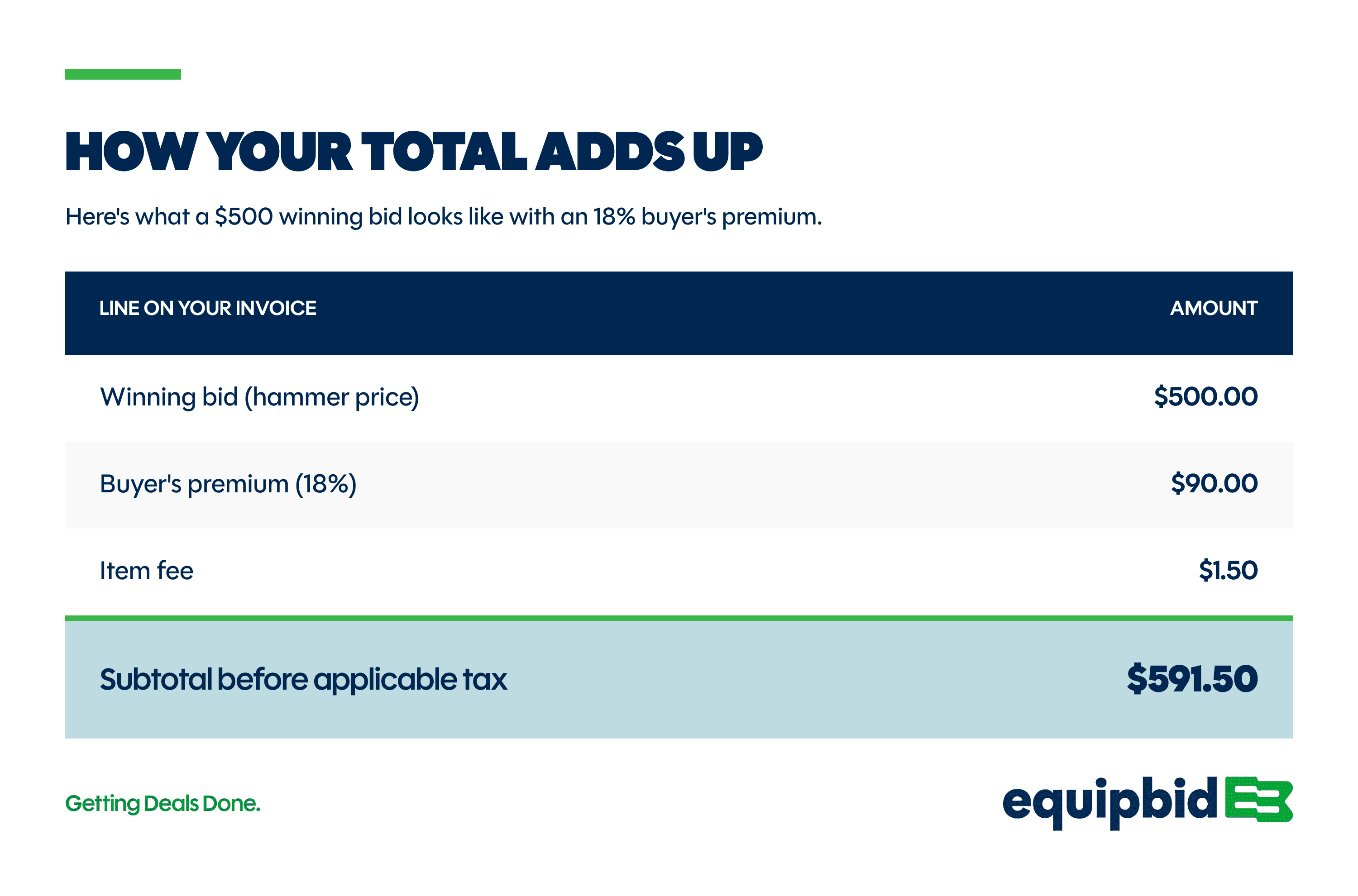
Applicable sales tax can increase the final amount you pay.
That means you shouldn't compare a $500 winning bid directly against a $700 alternative somewhere else.
Compare your estimated total cost.
For example, if you've decided an appliance is worth no more than $600 to you before applicable sales tax, bidding all the way to $600 doesn't accomplish that. The 18% buyer's premium and $1.50 item fee on a $600 winning bid add another $109.50.
7. Don't forget the costs outside the auction
Price isn't always the only cost involved with buying a large appliance.
Ask yourself whether you'll need to arrange:
- Transportation
- Installation
- Additional parts or accessories
- Help moving the appliance
- Disposal of your old appliance
Those aren't necessarily auction charges. They're simply part of understanding what the purchase will cost you.
A refrigerator you can transport and install yourself may have a different value to you than one requiring additional services.
Again, intended use matters.
So does your situation.
8. Use inspection when the details matter
Open Box appliance?
Damaged refrigerator?
Higher-dollar purchase?
If the auction offers inspection, consider going.
Equip-Bid specifically encourages bidders considering Open Box merchandise to use available inspection hours because the condition of Open Box items can vary widely.
Seeing an appliance in person can help you evaluate its physical condition and decide whether any visible issues matter for how you plan to use it.
Inspection isn't about finding a reason to buy something.
It's about gathering information.
Sometimes you'll walk away thinking, "That's exactly what I need."
Sometimes you'll decide to lower your maximum bid.
And sometimes you'll decide not to bid at all.
All three can be good outcomes.
9. Measure before you bid
There are few things more frustrating than scoring a great deal on an appliance that doesn't fit.
Before bidding on a refrigerator, range, washer, dryer or other large appliance, know the space you're trying to fill.
Then check the listing for available size or model information.
Don't forget the journey between your vehicle and the final destination either.
Think about:
- Doorways
- Hallways
- Stairs
- Corners
- Clearance around the appliance
- Your transportation
A beautiful refrigerator that's two inches too wide is not a beautiful deal.
Measure first. Bid second.
10. Have a transportation plan
Large appliances have an inconvenient habit of being large.
Before bidding, check the auction's pickup location, removal schedule and loading information.
Then figure out:
What vehicle do I need?
Can I safely transport the appliance?
Do I need a dolly or straps?
Do I need someone to help me?
Does the auction provide loading assistance, or am I responsible for removal?
Loading policies can vary between auctions, so don't assume someone will be available to load your purchase unless the auction terms say so.
Getting the winning bid is only part of the plan.
You still need to get the deal home.
11. Inspect before you leave
Pickup isn't the time to go on autopilot.
Make sure you're leaving with the correct merchandise and inspect your purchase as appropriate before leaving.
This is particularly important for Factory Sealed items.
Factory Sealed is the highest condition label, but it comes with a trade-off. Since the box hasn't been opened, nobody has checked what's inside. That's why we recommend inspecting Factory Sealed items before you leave pickup.
Know what you're taking home before you drive away.
12. Decide your maximum before the bidding gets exciting
You've researched the model.
You've studied the condition.
You've looked at the photos.
You've calculated the 18% buyer's premium and $1.50 item fee.
You know how you're transporting it.
Now comes the important part.
Decide what you're willing to pay.
Not what someone else is willing to pay.
Not how badly you want to win.
What the appliance is worth to you.
Suppose your limit is $700 and another bidder takes it beyond the number that makes sense for you.
Let them win.
The goal isn't to win every auction.
The goal is to find the right deal.
And there are always more deals ahead.
Your appliance auction checklist
Before bidding, run through this quick checklist:
Condition: Factory Sealed, Appears New, Open Box, Damaged, Partial or Incomplete?
Description: Did I read the whole thing?
Photos: Did I look through all of them?
Comparable value: What does this model or a comparable appliance cost elsewhere?
Intended use: Does the condition work for where and how I'll use it?
Total cost: Have I accounted for the 18% buyer's premium, $1.50 item fee, and applicable sales tax?
Additional costs: Will I need transportation, installation, or anything else?
Size: Will it actually fit?
Inspection: Would seeing it in person help me make a better decision?
Pickup: Can I meet the auction's removal requirements?
Maximum bid: What's the most I'm comfortable paying?
If you can answer those questions, you're in a much better position to decide whether you've found a deal.
Find the appliance that makes sense for you
Buying appliances at auction isn't just about paying less than a number you saw at a store.
It's about value.
A scratch-and-dent refrigerator might be perfect for one bidder and wrong for another. An Open Box washer might be worth the opportunity to one bidder while someone else prefers Appears New.
That's what makes auctions interesting.
You decide what the item is worth to you.
Understand the condition. Research comparable value. Calculate your total cost. Think about how you'll use it. Set your limit.
Then, when the right appliance and the right price come together?