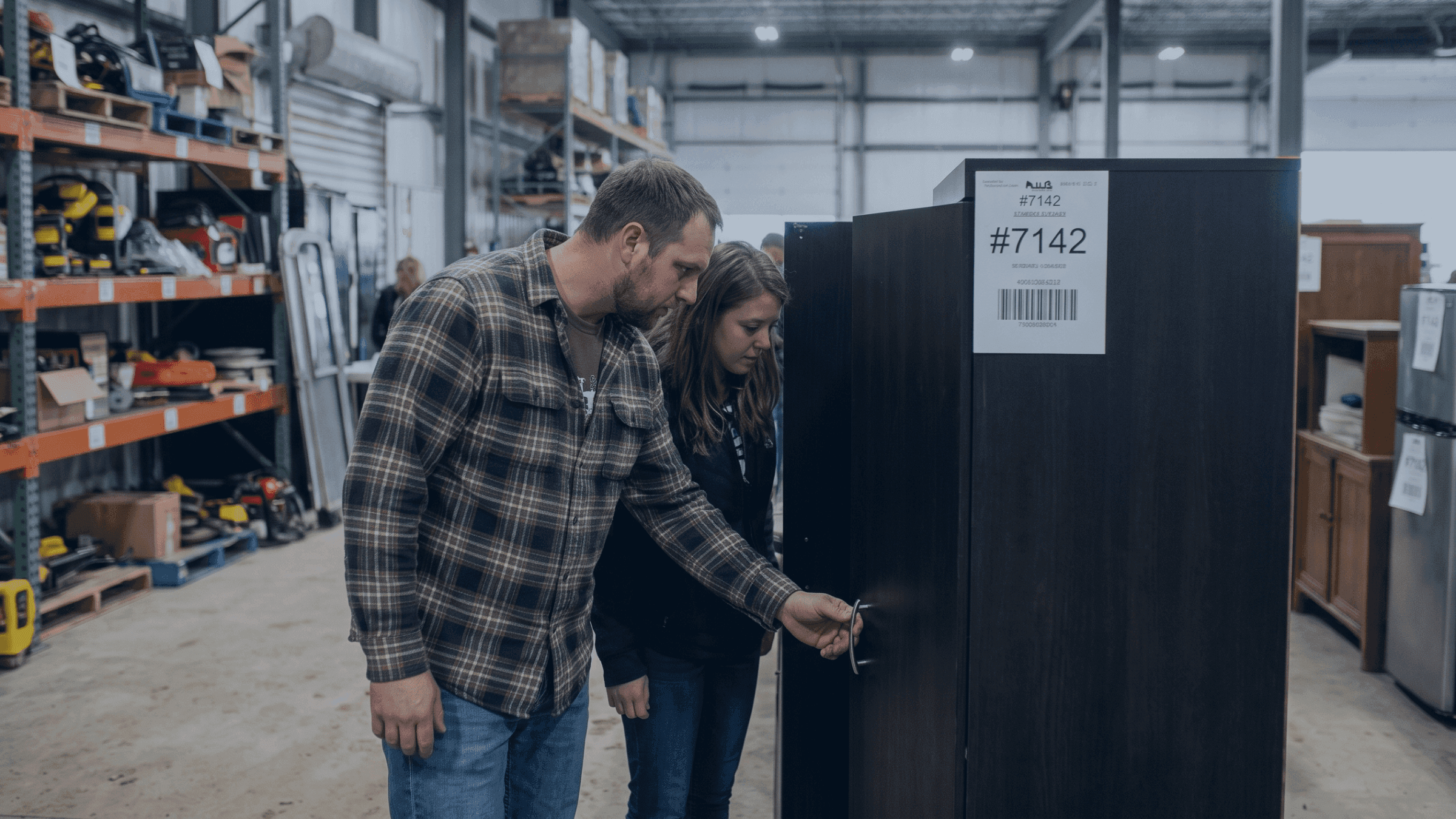
You found something you want.
The photos look good. The price is right. And you're already thinking about where you're going to put it.
Before you hit Bid, there's one more thing worth checking:
Is there an inspection?
Auction inspection gives you an opportunity to see merchandise in person before bidding. It can be especially valuable when you're considering Open Box or Damaged merchandise, equipment, or a higher-dollar purchase.
Think of it as doing your homework before staking your claim.
Here's how it works and why smart bidders take advantage of it.
What is an auction inspection?
An auction inspection is a designated opportunity to inspect items in person before an auction closes.
Depending on the auction, inspection availability, times and instructions can vary. That's why you should always check the specific auction information before making plans.
During an inspection, you can get a closer look at the things that aren't always easy to determine from a screen.
How big is it really?
Does the condition match what you need?
Is that scratch something you care about?
Does the equipment appear to have the components you're looking for?
Photos and descriptions give you important information. Inspection gives you another way to evaluate the item for yourself.
Where to find inspection details
Every auction lists its inspection information in two places.
On the auction page. Open the auction and select the Inspection Info tab. You'll see whether inspection is offered, plus the dates, times, location, and any instructions from the seller.
In your Dashboard. Go to My Appointments and choose the Inspection tab. Each appointment shows:
- How to schedule, such as a phone number to call
- The inspection address
- A Get Directions button
- A Chat button to message the seller with questions
If an auction requires an appointment, schedule it early. Inspection windows usually close before the auction does.
Why should you inspect an auction item?
Online auctions are all about opportunity, but smart bidding starts with knowing what you're buying.
Inspection can help you answer questions that matter to you before deciding how much you're willing to bid.
Maybe you're buying a $20 item and you're comfortable making your decision from the listing.
Maybe you're considering a piece of commercial equipment worth considerably more.
Those aren't necessarily the same buying decision.
The more important an item's exact condition, size, completeness or other physical characteristics are to you, the more valuable an in-person look can become.
Open Box? Inspection is your friend.
If there's one product condition where inspection deserves your attention, it's Open Box.
Open Box is Equip-Bid's broadest product-condition category.
Equip-Bid uses five condition labels: Factory Sealed, Appears New, Open Box, Damaged and Partial or Incomplete.
An Open Box item could be like new. It could be incomplete. It could be untested. It could also be nonfunctioning. Its condition or functionality hasn't been verified either way.
That's a pretty wide range.
It's also exactly why we encourage bidders considering Open Box merchandise to use available inspection hours and see the item in person before bidding.
An Open Box label doesn't automatically mean there's something wrong with the item.
It means take a closer look.
Read the description. Study the photos. And when inspection is available and the details matter to you, go see it.
What about Damaged items?
Inspection can be equally useful when you're considering something listed as Damaged.
Damaged means there's a known issue with the item. That could be shipping damage on an otherwise unused product, a scratch-and-dent appliance or something that's fully broken.
For one bidder, a dent might be a deal-breaker.
For another, it might be an opportunity.
Maybe the refrigerator is going in your garage and you couldn't care less about a dent on the side.
Maybe you're buying equipment for parts.
Maybe you know how to repair exactly what's wrong.
Inspection lets you evaluate the item based on your intended use, not someone else's.
Then you can decide what it's worth to you.
Equipment deserves a closer look
Buying equipment at auction can be a great way for businesses, contractors, farmers, DIYers and other Deal Seekers to find what they need.
It's also a category where details matter.
When inspection is offered, an in-person inspection can help you get a better understanding of the item's physical condition before bidding.
For larger equipment, you may want to pay attention to things like:
- Overall physical condition
- Visible wear or damage
- Included components or attachments
- Model and identifying information
- Size and dimensions
- Anything specifically mentioned in the listing
Just as important, read the description carefully so you understand what the seller has and hasn't represented about the item.
Inspection isn't a replacement for the listing.
It's another tool you can use alongside it.
Consider inspection for higher-dollar purchases
Everyone has a different definition of a "big purchase."
For one bidder, that's $200.
For someone else, it's $2,000.
The number isn't really the point.
If you're considering spending enough money that you'd be uncomfortable discovering something unexpected later, inspection may be worth your time.
You can look at the item yourself, compare what you see with the listing and make a more informed decision about your maximum bid.
That can turn:
"I hope this is what I think it is."
into:
"I've seen it. I know what I'm bidding on."
That's a much better place to bid from.
What should you look for during inspection?
What should you look for during inspection?
Don't just walk past the item and call it good.
Take a few minutes and actually look.
Start by reviewing the online listing before you arrive so you know what questions you want to answer.
Then inspect the things that matter for your purchase.
Check the overall condition. Look for visible damage. Make sure you understand what's included. Compare the item with the photos and description. If size matters, confirm it. If you're buying something that will require special transportation, start thinking about pickup while you're standing in front of it.
Photos, descriptions, and inspection work together
Inspection shouldn't be the first time you pay attention to an item.
The description, photos, condition label, and inspection each tell you something different. Use them together.
Each gives you information in a different way.
Photos show you the item and its visible condition.
Descriptions give you information supplied about the item.
Product condition gives you an expectation based on how the merchandise has been categorized.
Inspection gives you the opportunity, when available, to evaluate the physical item yourself.
Use all four and you've given yourself a much better foundation for deciding whether to bid.
Can't make the inspection?
Sometimes schedules don't cooperate.
If you can't attend an available inspection, that doesn't automatically mean you can't bid.
It does mean you need to decide whether you're comfortable making your purchasing decision based on the information available in the listing.
Read everything.
Look through all the photos, not just the first one.
Pay close attention to the product condition.
Consider what you know and, just as importantly, what you don't know.
Then decide whether you're comfortable bidding.
Sometimes the smartest bid is the one you're confident making.
And sometimes the smartest decision is waiting for the next deal.
Inspection can help you set your maximum bid
One of the best ways to approach an online auction is to decide what an item is worth to you before bidding gets exciting.
Inspection can help.
Suppose you're interested in an Open Box appliance.
You see it during inspection, and the physical condition is exactly what you need.
Great. Now you have more information to work with when setting your maximum.
Or maybe you notice something that makes the item less valuable for your particular situation.
Also useful.
Inspection isn't about convincing yourself to bid.
It's about helping you make an informed decision.
See it. Know it. Then bid.
Finding the deal is the fun part.
Doing your homework is what helps you bid with confidence.
Read the description. Look through the photos. Understand the product condition. Check the auction terms. And when inspection is available, especially for Open Box merchandise, Damaged items, equipment, and purchases where the details really matter, consider seeing it for yourself.
A little extra information can go a long way.
Then, when you've found the right opportunity at the right price?
Stake your claim.