A low bid doesn't automatically mean you've found a great deal.
And a higher-priced item isn't automatically a bad one.
The real question is: What is this item worth to you?
Finding a great deal at an online auction means looking beyond the current bid. Condition, comparable prices, fees, pickup costs and what you actually plan to do with the item can all change whether something is worth bidding on.
Before you hit that bid button, here are five things to consider.
1. Start with the item's condition
Two identical items can have very different values depending on their condition.
Before bidding, go through the entire listing. Don't stop at the first photo.
Look for:
- Visible wear or damage
- Missing pieces or accessories
- Rust, dents, cracks or other imperfections
- Mileage or operating hours when applicable
- Model and serial information
- Photos showing multiple angles
- Condition information provided by the seller
- Videos showing the item when available
Pay attention to what the listing doesn't tell you, too.
If something isn't shown or mentioned, don't assume it's included or guaranteed. If an important detail isn't clear, contact the seller before bidding when possible.
A $50 item that needs $200 in repairs may not be as good of a deal as the same item selling for $175 in better condition.
On the other hand, if you know how to make those repairs yourself, the $50 option might be exactly what you're looking for.
That's why condition and intended use go hand in hand.
2. Check what similar items actually cost
Before deciding something is a bargain, find out what your alternatives would cost.
Search for the same or similar item elsewhere.
Depending on what you're bidding on, you might compare:
- New retail prices
- Used retail prices
- Local marketplace listings
- Dealer listings
- Similar models
- Previous sales when available
Just make sure you're comparing similar items.
A newer model with fewer operating hours isn't necessarily a fair comparison to an older machine with heavy use. A refurbished appliance isn't the same as one being sold in used condition.
Brand, age, condition, specifications, location and included accessories can all affect value.
You don't need to become a professional appraiser. A few minutes of research can simply give you a reasonable range to work with.
3. Calculate your total cost, not just your bid
This is one of the easiest mistakes to make when bidding at an online auction.
The current bid is not necessarily your final total.
At Equip-Bid, an 18% buyer's premium and a $1.50 item fee are added to the winning bid. Applicable sales tax may also be added.
For example, imagine you win an item with a final bid of $500.
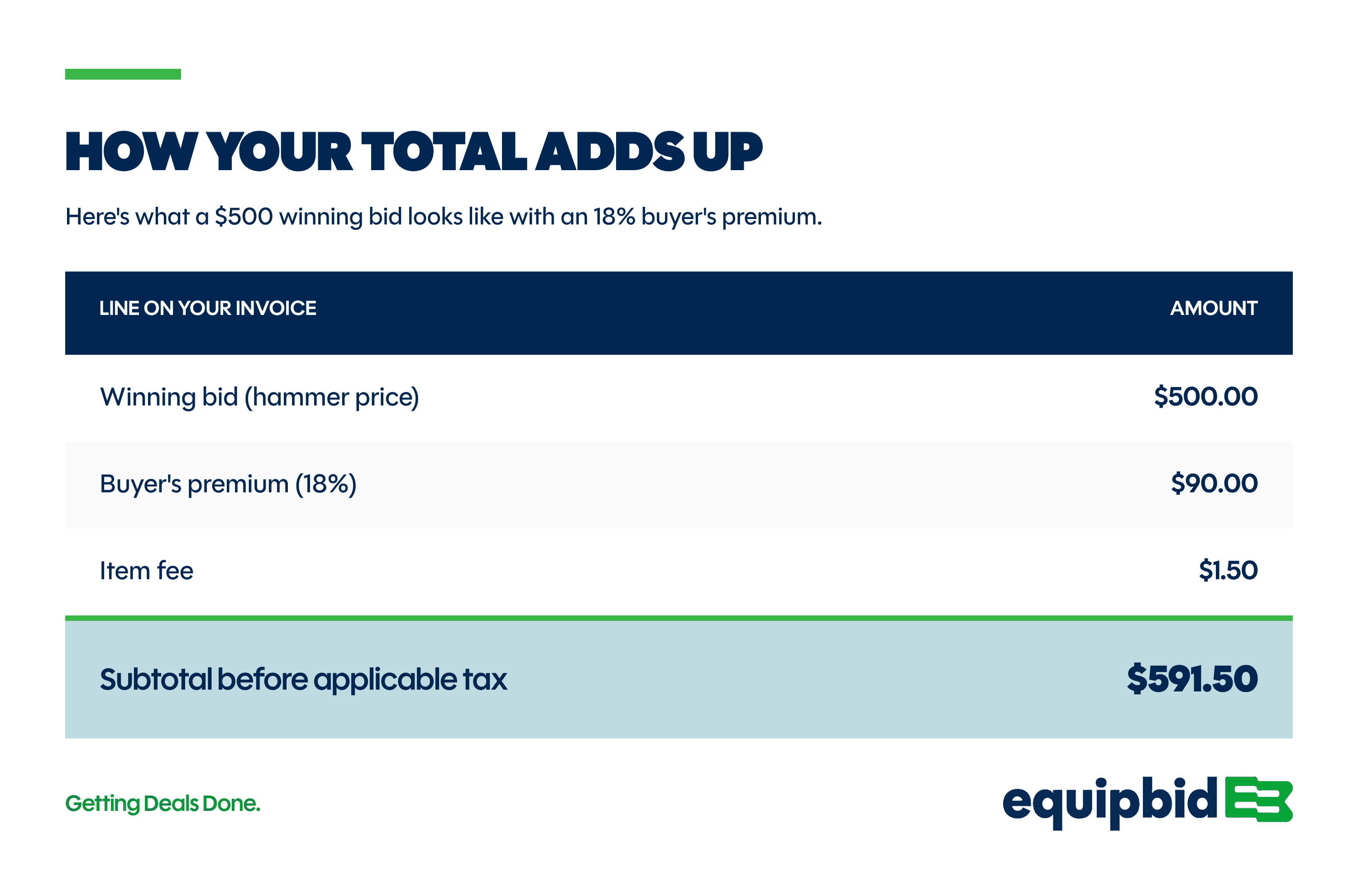
That means you shouldn't decide whether the item is a good deal based on $500 alone.
Compare its value against what you'll actually pay.
Before bidding, check the auction terms so you understand the buyer's premium and any other applicable costs.
4. Don't forget about pickup
You found a $75 item that normally costs $200.
Great deal, right?
Maybe.
What if pickup is three hours away?
Now your actual cost includes six hours of driving, fuel, and potentially a vehicle or trailer large enough to transport the item.
For larger purchases, you may also need to think about:
- Trailer rental
- Fuel
- Loading requirements
- Transportation
- Equipment needed for pickup
- Time away from work
- Help moving the item
This doesn't mean you should only bid on nearby auctions.
A good enough deal may absolutely be worth the drive.
Just factor that drive into your decision before you bid.
Always check the auction location, pickup date, and pickup instructions before placing a bid.
5. Ask yourself what the item is worth to you
This may be the most important step.
An item's value isn't exactly the same for every bidder.
Imagine a contractor is bidding on a tool that costs $1,500 new.
If that tool can immediately go to a jobsite and start making money, paying $900 for it may be a great deal.
Someone who only needs the same tool for one weekend project might decide it isn't worth more than $400 to them.
Neither person is necessarily wrong.
They simply have different intended uses.
The same idea applies to almost anything you can buy at auction.
A reseller needs enough room for a profit margin.
A homeowner may compare the price to buying new.
A collector may care more about rarity.
A business owner might care about how quickly the equipment can pay for itself.
Your maximum bid should reflect your situation, not somebody else's.
Create your maximum price before the bidding gets competitive
Once you've done your research, decide what you're comfortable paying.
Start with the maximum total cost that would still make the purchase worthwhile.
Then work backward.
Consider:
Item value → condition → buyer's premium → item fee → taxes → transportation or repairs → your maximum bid
This gives you a number based on actual reasoning rather than the excitement of the auction.
Because once another bidder enters the picture, it can be tempting to think:
"It's only another $10."
Then another $10.
Then another.
And suddenly you've spent much more than you planned because you wanted to win.
Winning the auction isn't the goal.
Winning the item at a price that makes sense is.
A cheap item isn't always a great deal
Imagine there are two commercial refrigerators available.
Option A
Winning bid: $250
Needs repairs
Two-hour drive for pickup
Option B
Winning bid: $500
Appears to be in better condition
Pickup is 20 minutes away
The $250 refrigerator is cheaper.
But that doesn't necessarily make it the better deal.
Once you consider repairs, transportation, and your time, the $500 refrigerator could make much more sense.
Price is only one part of value.
Sometimes the best deals aren't the obvious ones
Everyone notices the flashy stuff.
That can mean some of the best opportunities are hiding elsewhere in an auction.
Browse beyond the featured items. Look through entire catalogs. Search different categories. Pay attention to items with less competition.
You might discover:
- A lesser-known brand that fits your needs
- An older model with plenty of useful life left
- A lot containing a group of several items you need
- Business equipment that isn't useful to the average shopper
- An item you can repair yourself
- Something listed in a category you wouldn't normally browse
That's part of the treasure hunt.
Knowing what you're looking at can sometimes be just as valuable as knowing what you're looking for.
Know when it's no longer a deal
Sometimes another bidder simply values the item more than you do.
That's okay.
If bidding passes the number you decided made sense, you don't have to keep going.
There will be more auctions.
A great bidder isn't someone who wins everything they bid on.
It's someone who knows what they're willing to spend and can walk away when the numbers stop making sense.
Your great deal might be different from someone else's
There isn't one magic percentage that makes something a good auction buy.
A great deal could mean getting equipment your business needs for less than your alternatives.
It could mean furnishing an apartment without buying everything new.
It could mean finding a discontinued part you've been searching for.
Or it could mean winning something completely unnecessary that you just really, really wanted.
Before you bid, remember the five things that matter:
Condition. Comparable value. Total cost. Pickup. Intended use.
Do the math, read the listing, and decide what the item is worth to you.
Then comes the fun part.