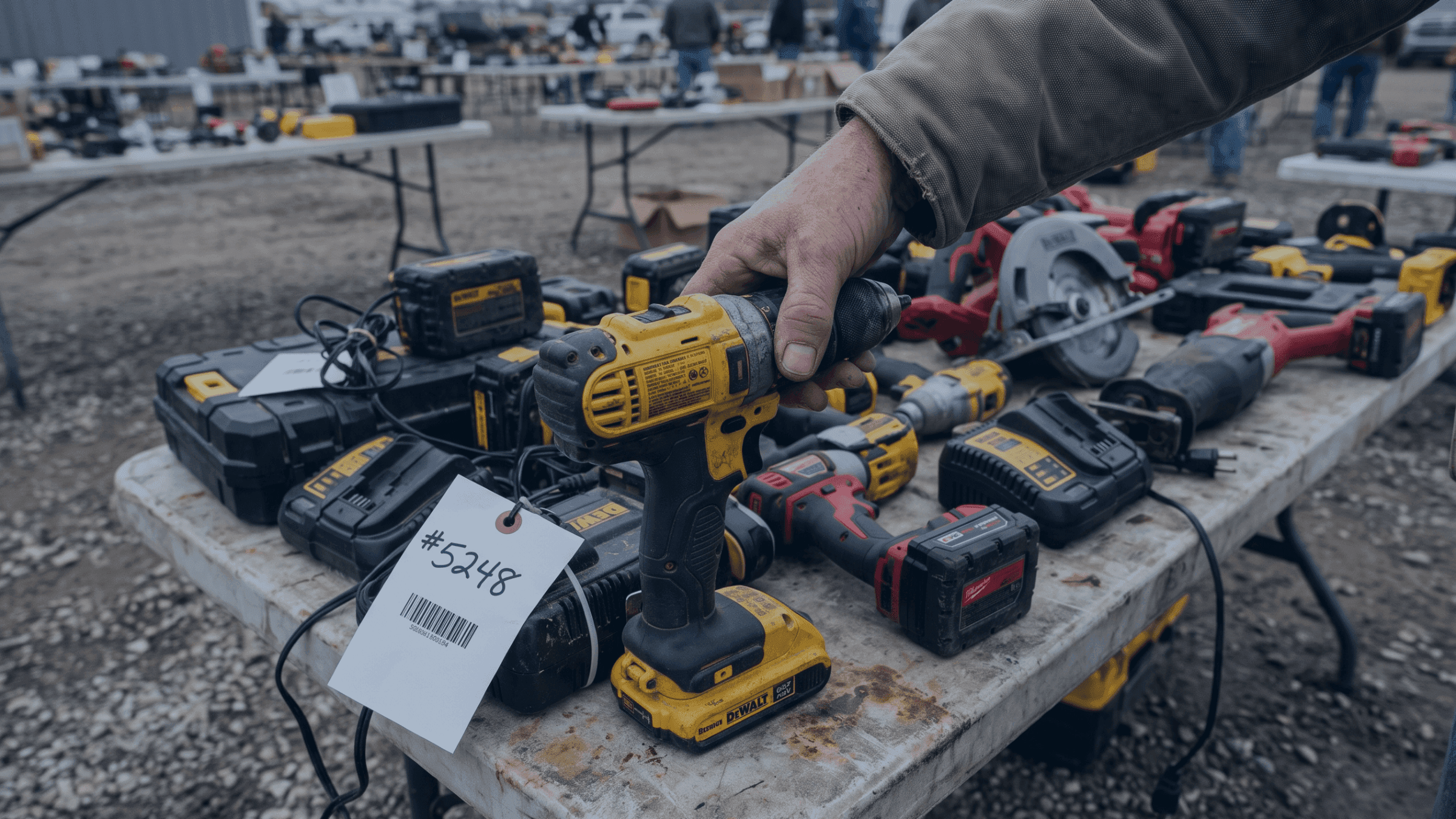
There’s something particularly satisfying about getting a deal on a tool you actually need.
A cordless drill for the next project. A new saw for the shop. An air compressor for the garage. Maybe an entire toolbox that would cost considerably more to build piece by piece.
Whether you're a contractor, business owner, DIYer or someone who believes there's no such thing as too many tools, online auctions can be a great place to look.
But a great price isn't the only thing that matters.
Before you stake your claim, here’s what to look for when buying tools at auction.
1. Start with the product condition
Before you look at the current bid, check the condition.
At Equip-Bid, you'll generally see five product conditions: Factory Sealed, Appears New, Open Box, Damaged, and Partial or Incomplete.
Those labels tell you what is known about the item and can help you decide how comfortable you are bidding.
Factory Sealed means the package hasn't been opened and the product hasn't been handled. But because the package hasn't been opened, what's inside hasn't been verified.
Appears New means the item looks unused. The box may be damaged. It may or may not have its original packaging, but it has been looked over, doesn't appear pre-owned, and appears complete enough to function.
Open Box is a much broader category. An item could be like new, incomplete, untested or nonfunctioning. Its condition or functionality hasn't been verified either way.
Damaged means there's a known issue. That could be anything from shipping or cosmetic damage to an item that's fully broken.
Partial or Incomplete means the product originally shipped in more than one box, and not every box may be there. This comes up a lot with larger shop equipment and tool storage. Items listed as partial or incomplete are sold as-is.
When you're buying tools, those differences matter.
A Factory Sealed drill and an Open Box drill might look similar in search results, but you shouldn't evaluate them the same way.
2. Read the entire description
We know.
The picture shows a circular saw. You want a circular saw.
What else is there to know?
Potentially quite a bit.
The item description may contain information that isn't obvious from the title or first photo. Before bidding, read the entire listing and understand exactly what the seller is representing.
This becomes particularly important with tool sets, kits and Open Box merchandise.
Don't assume something is included simply because you'd normally expect it to come with the product.
Bid on what's listed, not what you hope is in the box.
3. Look through every photo
The first photo gets your attention.
The rest can help you make your decision.
Zoom in and look for details that matter to you.
For used, Open Box or Damaged tools, you might want to pay attention to visible wear, cracks, missing pieces, damaged cords, rust or other signs of condition.
For sets and kits, use the photos alongside the description to understand what's being offered.
And if something catches your eye?
Don't ignore it.
Decide whether it affects what the tool is worth to you.
That's the beauty of an auction. Different bidders can look at the same item and come to completely different conclusions about its value.
4. Check what's included
This deserves its own section because tools love accessories.
Batteries.
Chargers.
Cases.
Blades.
Bits.
Sockets.
Attachments.
Guards.
Handles.
One missing component can make a big difference depending on what you're buying.
For cordless power tools in particular, pay attention to whether the listing indicates that a battery and charger are included.
If you already own compatible batteries, a tool-only purchase might be exactly what you're looking for.
If you don't, you'll want to factor the cost of anything else you'll need into your bidding decision.
The same applies to tool sets.
Don't assume a 200-piece case contains every piece it originally had unless the listing supports that conclusion.
Read. Look. Know what you're bidding on.
5. Know your battery platform
If you're buying cordless tools, this one can save you some headaches.
A battery-powered tool is part of a larger system.
Pay attention to the brand, battery platform and voltage shown or described in the listing.
If you already have a collection of compatible cordless tools, finding another tool that works with batteries you own can make an auction find even more useful.
If you're entering a new battery platform, remember that you may need batteries and a charger if they're not included.
That doesn't make it a bad deal.
It just changes the math.
6. Use inspection when you need a closer look
Sometimes photos and descriptions give you everything you need.
Sometimes you want to see the tool yourself.
When an auction offers inspection hours, use them.
Inspection can be especially valuable for Open Box or Damaged tools, larger shop equipment and higher-dollar purchases.
Equip-Bid specifically encourages inspection for Open Box merchandise because of how widely that condition can vary.
If you're considering something where exact physical condition matters to your decision, seeing it in person can give you more information before you set your maximum bid.
Inspection isn't there to convince you to buy.
It's there to help you make an informed decision.
7. Research before you decide what it's worth
Here's where you can really start bidding smarter.
Before deciding your maximum bid, know what you're comparing the auction item against.
Look at the exact model when possible.
Consider its condition.
Consider what's included.
Consider what you'd have to buy separately.
And remember that retail price isn't automatically auction value.
A brand-new tool sold by a retailer and an Open Box tool with an unknown history aren't necessarily equivalent purchases.
Do your research, evaluate the actual item in front of you and decide what you're comfortable paying.
Then set your limit.
8. Remember the buyer's premium and applicable tax
You found a $200 tool for $100.
Great deal?
Maybe.
But don't stop the math at your winning bid.
Equip-Bid has an 18% buyer's premium, so a $100 winning bid becomes:
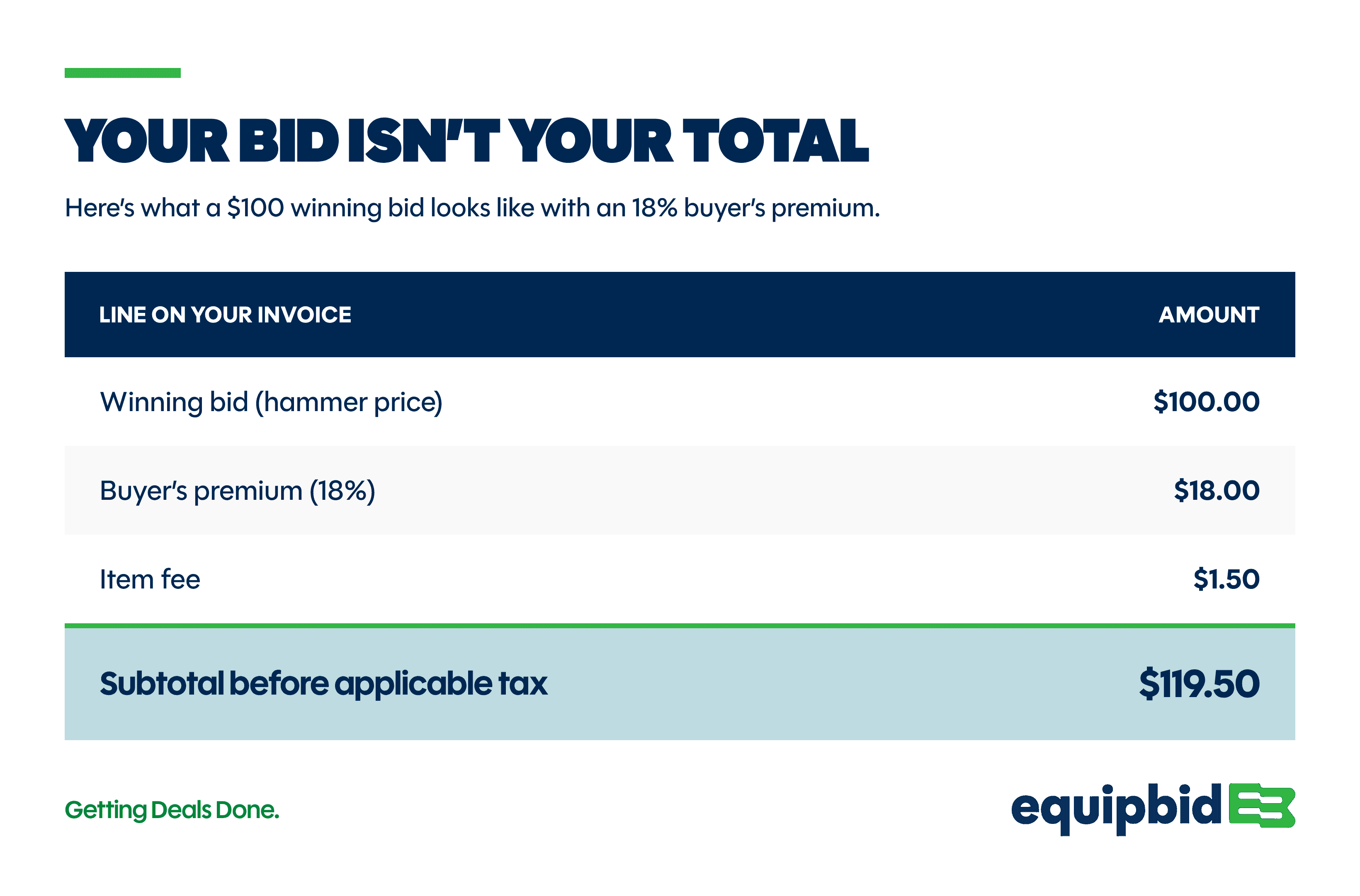
Applicable sales tax and any other charges disclosed in the auction terms can affect the final amount you pay.
That's why experienced bidders think in terms of total cost, not just winning bid.
Before you start bidding, decide what you're willing to spend all-in and work backward from there.
9. Think about what happens if it needs something
Sometimes a tool doesn't need to be perfect to be useful.
A contractor may know exactly how to replace a part.
A DIYer might not care about cosmetic scratches.
Someone who already owns compatible batteries may see value in a tool another bidder passes over.
And a bidder looking for parts may evaluate a Damaged tool completely differently from someone who needs it ready for tomorrow's job.
Ask yourself:
What am I buying this for?
Then evaluate the item based on that purpose.
A tool can be a great deal for one bidder and completely wrong for another.
10. Have a plan for larger equipment
Not every tool fits in a toolbox.
Equip-Bid auctions can include larger shop and commercial equipment, and those purchases require a little more planning.
Before bidding, check:
- Pickup location
- Pickup date and time
- Approximate size
- Transportation needs
- Loading requirements
- Any special removal instructions in the auction terms
Don't assume loading assistance will be available unless the specific auction says so.
That floor-standing piece of equipment might look like a fantastic deal.
It'll look a little less fantastic if you arrive in a sedan.
11. Don't let bidding become a competition
You researched the tool.
You looked at the condition.
You know what's included.
You decided you'd go up to $175.
Then somebody bids $180.
You know what happens next.
"What's another five bucks?"
Then another.
And another.
Auctions are exciting because you're competing with other bidders. But the goal isn't simply to beat the person on the other side of the screen.
The goal is to get something you want at a price that makes sense for you.
Set your limit based on the item, its condition and your total cost.
If somebody else values it more?
Let them have this one.
There are more deals ahead.
Tools for the garage, jobsite and everything in between
One of the best things about shopping auctions is the variety.
Depending on current inventory, you might find:
- Cordless power tools
- Drills and impact drivers
- Saws
- Sanders and grinders
- Nailers
- Air compressors
- Hand tools
- Socket and wrench sets
- Toolboxes and storage
- Automotive tools
- Lawn and outdoor power equipment
- Shop equipment
- Construction tools
- Commercial equipment
- Tool accessories and batteries
And because Equip-Bid is an online auction marketplace rather than a traditional retailer, what's available keeps changing.
Today's auction might not have what you need.
Tomorrow's might.
A better tool-buying checklist
Before you place your next tool bid, ask yourself:
What's the product condition?
Did I read the entire description?
Did I look through all the photos?
What's actually included?
If it's cordless, do I have the right battery and charger?
Would an inspection help me make a better decision?
What does this model cost elsewhere?
What's my total cost after the 18% buyer's premium, $1.50 item fee, and applicable tax?
Can I pick it up when and where required?
What's the most I'm willing to pay?
If you've answered those questions, you're ready to make a much more informed bid.
Find the tool. Do the homework. Make the deal.
Buying tools at auction isn't about finding the lowest number on the screen.
It's about finding the right opportunity.
Know the condition. Understand what's included. Look closely at the listing. Inspect when it matters. Calculate your total cost. Then decide what that tool is worth to you.
Maybe you're filling your first toolbox.
Maybe you're outfitting an entire shop.
Or maybe you just spotted another cordless tool that technically wasn't on your shopping list.
We won't judge.
Deals ahead.