Buying commercial equipment is rarely a small decision.
Whether you're replacing a machine, outfitting a new location, expanding production or adding capacity, the equipment you buy has to make sense for the business.
That's one reason online auctions can be worth a look.
Equip-Bid regularly features business and commercial assets including restaurant equipment, construction equipment, farm and agricultural machinery, heavy equipment, business furniture and other specialized equipment.
But buying commercial equipment at auction takes more than spotting a low current bid.
The smartest bidders look at condition, comparable value, total cost and intended use before deciding what an item is worth to them.
Here's how to approach it.
Start with the job the equipment needs to do
Before you look at price, ask a more important question:
What do we need this equipment to accomplish?
Maybe you're replacing a machine that's down.
Maybe you're opening a second location.
Maybe you need additional equipment for seasonal demand.
Maybe you're buying something for occasional use and don't need the newest model available.
Intended use can completely change what makes sense.
A piece of equipment with cosmetic wear may be perfectly acceptable in a warehouse or production environment.
A machine that will run every day in a critical operation may deserve a different level of scrutiny.
Don't start with:
"How cheap can we get it?"
Start with:
"Will this do the job we need it to do?"
Understand the condition before you bid
Commercial equipment can come to auction from many different situations, including business liquidations, facility closures, surplus inventory and equipment changes.
That makes condition especially important.
Read the complete item description and review every photo before bidding.
Look for any information provided about:
- Operating condition
- Known damage
- Age or model
- Hours or mileage, when provided
- Included accessories or attachments
- Missing components
- Power requirements
- Dimensions
- Pickup requirements
Don't assume something has been tested unless the listing says it has.
And don't assume an attachment, cable, accessory or component is included simply because that piece would normally come with the equipment.
Bid on what's actually represented in the listing.
Use inspection when the equipment matters to your operation
For commercial equipment, an in-person look can be especially valuable.
If inspection is offered, consider using it for higher-dollar purchases, specialized machinery or anything where physical condition could affect your decision.
An inspection may help you better understand things such as visible wear, configuration, dimensions, included components and overall physical condition.
It can also help you answer a practical question:
Is this actually the right piece of equipment for our operation?
Inspection isn't a guarantee of future performance.
It's another source of information you can use before deciding what you're willing to spend.
Research comparable value, but compare the right things
Suppose you're looking at a piece of equipment that costs $20,000 new.
Current bid: $6,000.
Great deal?
Possibly.
But those two numbers don't tell the whole story.
When researching comparable value, try to compare:
- Same or similar model: A newer generation may have features or capacity the auction item doesn't.
- Similar age: Equipment values can change significantly over time.
- Comparable condition: New retail equipment and used liquidation equipment aren't identical purchases.
- Included components: Attachments, accessories and tooling can materially affect value.
- Hours or usage: When that information is available, factor it into your comparison.
- Location: Transportation can be a meaningful expense on commercial equipment.
The manufacturer's original retail price can provide context.
The more useful question is:
What would it cost us to get comparable equipment that meets the same need?
That's the number worth comparing.
Calculate your total cost, not just your bid
This is where commercial bidders need to be especially careful.
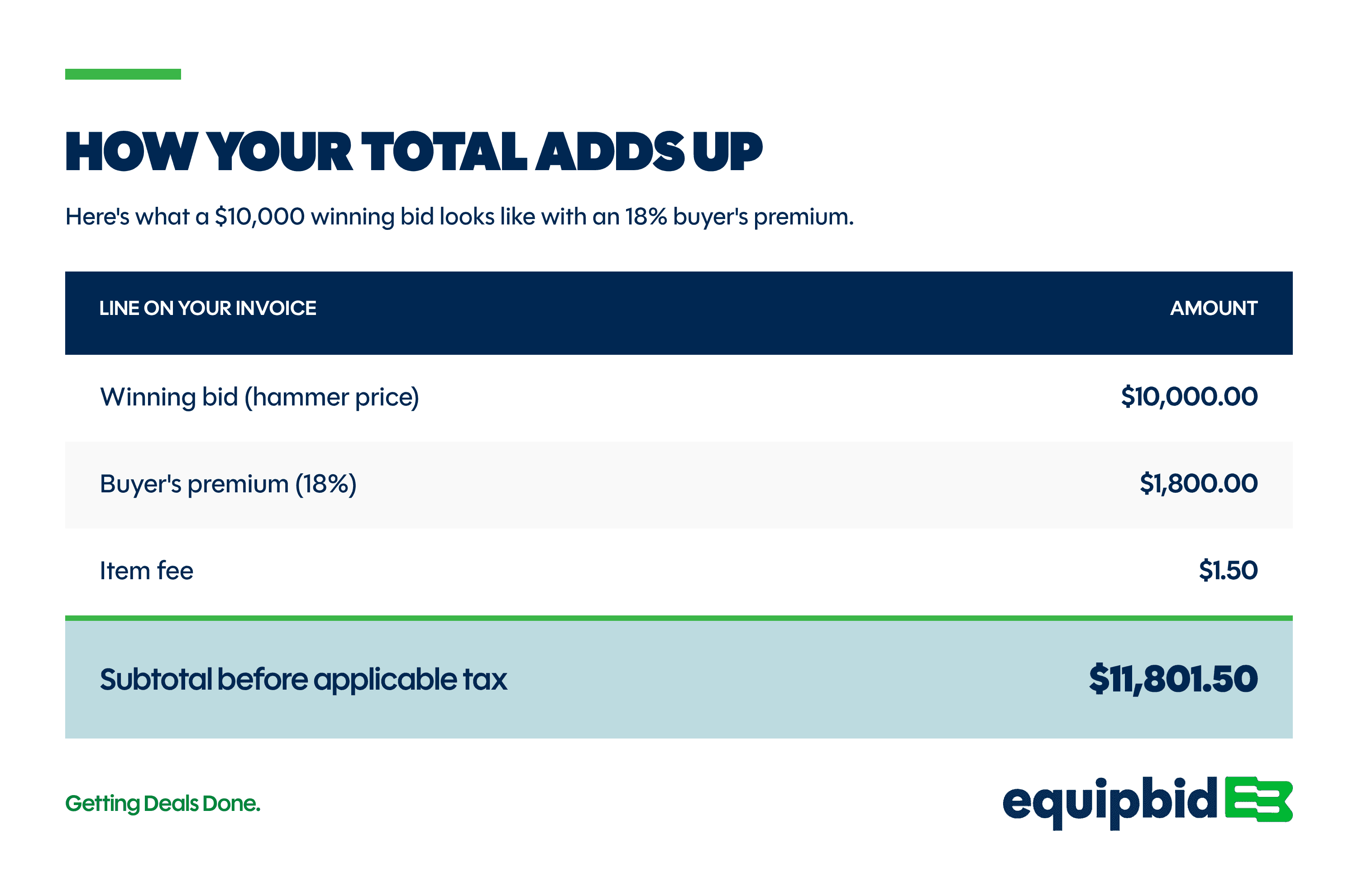
Equip-Bid currently charges an 18% buyer's premium on our most auctions. If sales tax applies, it's charged on the winning bid plus the buyer's premium.
So a $10,000 winning bid would look like this before applicable tax:
Invoices over $2,000 can’t be paid by credit card. You’ll pay by wire transfer using the instructions on your invoice.
Now add any other costs associated with getting that equipment operational.
Depending on the purchase, that could include:
- Transportation
- Rigging
- Loading or unloading
- Installation
- Electrical or utility work
- Repairs
- Replacement parts
- Inspection or servicing
- Required accessories
Those aren't necessarily auction fees.
They're part of your real acquisition cost.
A $10,000 winning bid isn't automatically a $10,000 piece of equipment.
Smart bidders calculate what it will cost to get from winning bid to working asset.
Know your power and facility requirements
This is one of those details that's easy to overlook until it's expensive.
Commercial equipment may require specific electrical service, gas connections, ventilation, floor space, ceiling clearance or other facility requirements.
Before bidding, find out what you can from the listing and available model information.
Ask yourself:
Will it fit?
Can our facility power it?
Do we have the right utilities?
Will installation require facility modifications?
Does our operation have enough capacity for it?
The right machine at the wrong facility can become a very expensive problem.
Check capacity, not just brand and model
Bigger isn't automatically better.
Neither is cheaper.
If you're buying commercial refrigeration, manufacturing equipment, restaurant equipment or material-handling equipment, capacity matters.
Think about what your business actually needs.
An oversized machine can consume more space and resources than necessary.
An undersized one can become a bottleneck.
The goal is not just to buy equipment.
It's to buy equipment that fits the operation.
Look closely at attachments and accessories
With commercial machinery, what's included can make a major difference in value.
Construction equipment is a good example.
Equip-Bid auctions regularly include construction equipment, heavy equipment, farm implements, attachments and material-handling equipment.
A skid steer with the attachment you need can represent a very different purchase from a machine sold by itself.
The same applies across industries:
- Restaurant equipment may need racks, pans or specialized accessories.
- Manufacturing equipment may require tooling.
- Warehouse equipment may require batteries or chargers.
- Farm machinery may require specific implements.
Read the description carefully and study the photos.
If something isn't listed or shown clearly, don't build your bid around assuming it's included.
Factor transportation into the decision early
A commercial refrigerator isn't going in the back seat of your Honda.
Neither is a skid steer.
Before bidding on larger equipment, check the auction location and determine how you'll get the item to your facility.
Think about:
- Weight
- Dimensions
- Trailer requirements
- Freight costs
- Loading equipment
- Rigging
- Unloading at your facility
- Route or permitting requirements when applicable
Equip-Bid auctions can have different loading and pickup procedures, so check the specific auction terms before bidding.
Don't assume the seller will load your purchase unless the auction says so.
Transportation shouldn't be something you figure out after the congratulations email arrives.
Read the auction terms before committing
Commercial purchases can be large enough that the fine details matter.
Review the auction-specific terms for information about:
- Payment methods
- Pickup dates
- Pickup deadlines
- Loading assistance
- Required appointments
- Tax information
- Any auction-specific charges or requirements
Read the terms for every auction before you bid. Every bid is binding, and the terms spell out what happens if something goes wrong. If you don't pay, you can be charged the resale costs and lose your bidding privileges. If you miss your pickup window, you may owe storage fees or lose the items altogether.
Reminder: invoices over $2,000 can’t be paid by credit card. You’ll pay by wire transfer using the instructions on your invoice.
If you're bidding on a major piece of equipment, five minutes spent reading the terms is a pretty good investment.
Think about downtime and business risk
Price matters.
So does reliability.
If a machine is going into a mission-critical part of your operation, ask yourself what happens if it needs repair.
Can your business tolerate downtime?
Do you have another machine as backup?
Are parts readily available?
Can your maintenance team service the equipment?
Is there a local technician who works on that brand?
A lower purchase price may still make perfect sense.
You just want to understand the tradeoff you're making.
An auction purchase for occasional use and an auction purchase that will become the heart of your production line deserve different levels of risk tolerance.
Set your maximum based on business value
Auctions can get competitive.
The other bidder may be another contractor.
Another restaurant owner.
Another farmer.
Another business that wants exactly what you want.
That's fine.
Their maximum doesn't need to become yours.
Build your number from the business case:
Comparable equipment value
minus expected transportation and setup costs
minus repairs or additional components you may need
while accounting for the 18% buyer's premium, $1.50 item fee, and applicable tax
Then decide what the equipment is worth to your operation.
If bidding goes past that number, you've learned something useful.
The equipment makes more sense for someone else.
There will be another opportunity.
Commercial equipment you can find at Equip-Bid
The mix changes constantly, but you'll regularly find categories like:
- Construction equipment
- Heavy equipment and machinery
- Farm and agricultural equipment
- Restaurant equipment
- Material-handling and storage equipment
- Business furniture
- Automotive and mechanical equipment
- Commercial supplies
- Tools and shop equipment
- Vehicles and specialty assets
Business liquidations and commercial property are a big part of what we do. On any given week, you might find skid steers, farm attachments, restaurant equipment or food-production assets.f
For businesses, that creates another place to source equipment beyond traditional dealers and retail channels.
Your commercial equipment bidding checklist
Before placing a bid, ask:
Does this equipment fit the job we need it to do?
Did we read the full description and inspect every photo?
Do we understand the known condition?
Would inspection help us make a better decision?
What does comparable equipment actually cost?
What's included with this lot?
Will it fit our facility and meet our power or utility requirements?
What is our total cost after the 18% buyer's premium, $1.50 item fee, and applicable tax?
What will transportation, installation, or repairs cost?
Can we meet the auction's pickup and removal requirements?
What's the most this asset is worth to our business?
If you can answer those questions, you're bidding from a business plan instead of just a number on a screen.
Buy the equipment that moves your business forward
Commercial equipment is an investment.
Whether you're spending hundreds or tens of thousands of dollars, the goal is the same:
Get the equipment your business needs at a cost that makes sense.
Understand the condition. Research comparable value. Calculate the full cost. Think about how the equipment will be used. Plan for transportation and installation. Then set the number that works for your operation.
Equip-Bid was built around connecting people with opportunity, including businesses looking for the equipment and assets they need to keep moving.
Find the right equipment.
Make the numbers work.
Then get back to business.